


Characterising Liquid Bridges for Applications in 3D-Printed Nutraceuticals
“This summer, I carried out a UROS-funded research project under the supervision of Dr Claire McIlroy studying the curvature of a family of capillary liquid bridge shapes. Using the open-source software “Surface Evolver”, we were able to identify an approximate relation between the total Gaussian curvature of a bridge and the dihedral angles of its nonparallel boundary surfaces.
This is the second UROS project I have done so far and has been my first (relatively) independent journey into the world of applied mathematics. Prior to this project, I had enthusiastically taken up opportunities to explore various topics in pure mathematics, notably group theory and topology. Thus, the computational aspects of this project were initially quite daunting. I may have had experience working computationally, but using a computer program to systematically calculate precise values and analyse results was a skill I didn’t readily tend to.
Despite this, the incredible support from my supervisor kept me motivated to work on the project and excited to find out what we might discover. “ – Ewan Dalgliesh, Mathematics
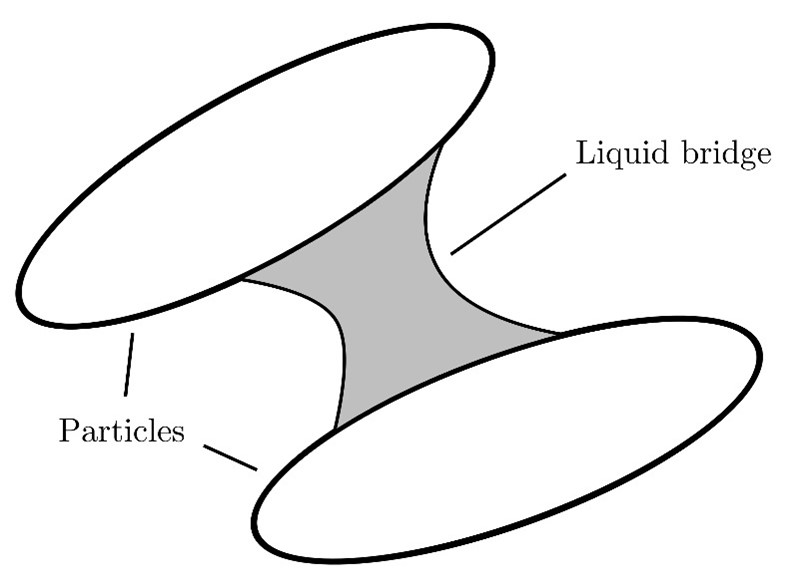
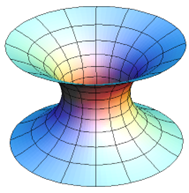
A liquid bridge between two particles (left), which typically takes the shape of a catenoid – a minimal surface (right).
Categories: Updates

 Centre for Computational Physics